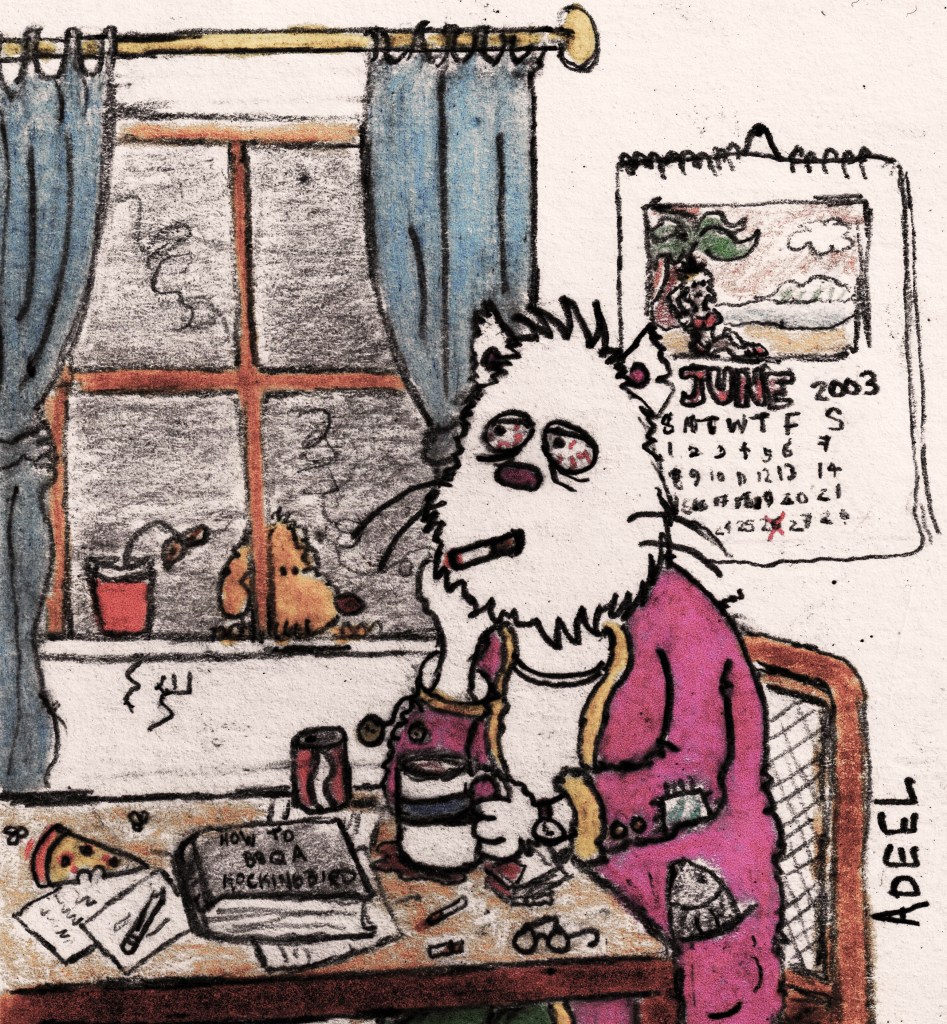
He sits with a cup of yesterday’s coffee, exhaling slow into the purple vesper of evening. A cloud coils from his lips, spiraling like a lazy helix, lingering midair. Ghosts of past, present and what-could’ve-been joined together in this day’s passing. An earthy murk, heavy but fleeting, fills the room.
He’s withdrawn, yet not. Full and empty, all at once. Abstract, but nevertheless empirical. Still as a rock, yet loud enough to rattle the windows of the Universe. A contradiction? Sure. An irregularity? Maybe. But then again—our Cosmos thrives on inconsistencies. Only because we insist on naming them so.
With his spine curved, he stares deep, hard into the gummy, bloodshot eyes of the abyss.
And the abyss sucker-punches back. Knocks out a tooth or two.
He gets up. Brushes the cigar ash off his beard, his clothes, his conscience. Sits back down. The chair creaks. The silence grows teeth.
He’s not blocked, not exactly. It’s just that nothing feels true, nothing feels real. Every line feels stolen, every emotion borrowed, every memory pilfered. The real story’s tangled up in his chest, choking him, but he knows, no damn words can ever set it free.
Maybe he doesn’t know what he really feels anymore.
by Adeel Babree
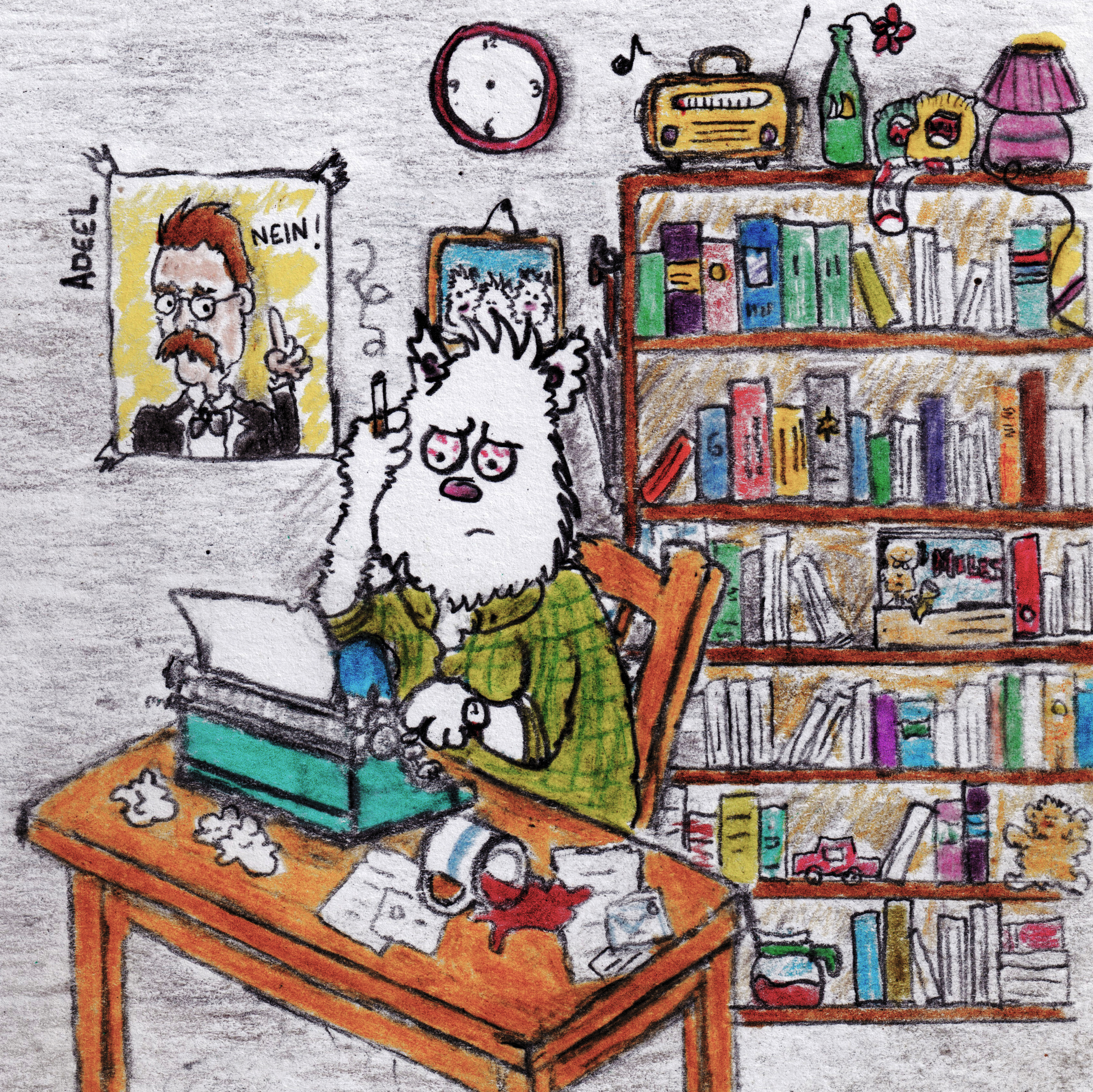
He sits at the table. Wooden, worn, wizened — carved from some stubborn tree that refused to fall quietly. Time had left scratches, dings, coffee rings, the occasional cigarette burn, but it hadn’t broken its back, yet. No, this old altar of thought, that once belonged to his father, still stood sturdy, a keeper of secrets, a silent conspirator in midnight schemes.
Drawers stuck half-open like mouths mid-confession, coughing up battery cells, a forgotten Game & Watch—solid brown, scuffed plastic—Donkey Kong. A cassette tape labeled Radio City Hits ’94, ribbon chewed to death. A Nady microphone, long mute. A harmonica, its metal beaten out of shape by decades of breath, flat sevens, and heartbreak, lay next to a Buddha statue—ancient-looking, top half of its head missing, yet somehow still smiling. A matchbox done in by the monsoon—the kind of damp that seeps through kitchen cabinets, a packet of rusks, and old letters you should’ve thrown away a long time ago. Loose change. Loose keys. Bits of string, paperclips, bank receipts of a dormant account—colorful miscellanea. The absurd balance of soul and junk.
Sticky notes spewed out like leaves caught in a wind, scribbled with lyrics, unfinished ideas that smelled genius or madness, depending on the hour. A calculator blinked, still believing it had one last equation in it.
In the corner, an old radio crackled: “…Inzamam flicks Walsh for a single…”
And right there, dead center —in all the chaos, the clutter,
still, untouched, holy —
A blank piece of paper.
Calling.
Waiting.
Daring.
As if saying, “Alright poet, your move.”
The writer shifts. Uneasy.
With quiet resolve, he writes—
Where do I begin?
by Adeel Babree
He watches the empty space in front of him, as if, it’ll answer. He leans back and murmurs…
“I have no f*ckin’ idea.”
What were words – that burst out of me in my youth – much like war cannons – loud and many – tearing through pages like an unstoppable force at terrifying speeds – today – they hide behind pensive, tired eyes, behind bookshelves, in corners, in shadows, in fractures of my soul. Ashamed for their past pride and tall claims. Their dying faint whispers, I no longer understand.
And it’s not easy to confess something like that.
Especially for one who’s spent most of his adult life pretending he’s a writer. And one who has played the part with such great flair. I’ve looked the part. Scruffy beard. Long-hair bunched up in a ponytail. Raggedy shot-up cardigans with Colin Wilson sticking out my jeans’ back-pocket. I’ve sat in doofus hip cafes. Written bad poetry while sipping cappuccinos with names that sound like folk bands. (What the hell is a Foggy Morning Drizzle?) I’ve written angry letters-to-the-editor, demanding revolutions from my chair. With posters of Bukowski, and Herman Hesse plastered on walls, I’ve suffocated and strangled my demons with stogies – thick, rugged, a taste like burnt furniture and old secrets—smoked slow by men who’ve seen too much and say too little. On dark, windless nights – I’ve contemplated meaning, and begged the heavens for answers they never promised.
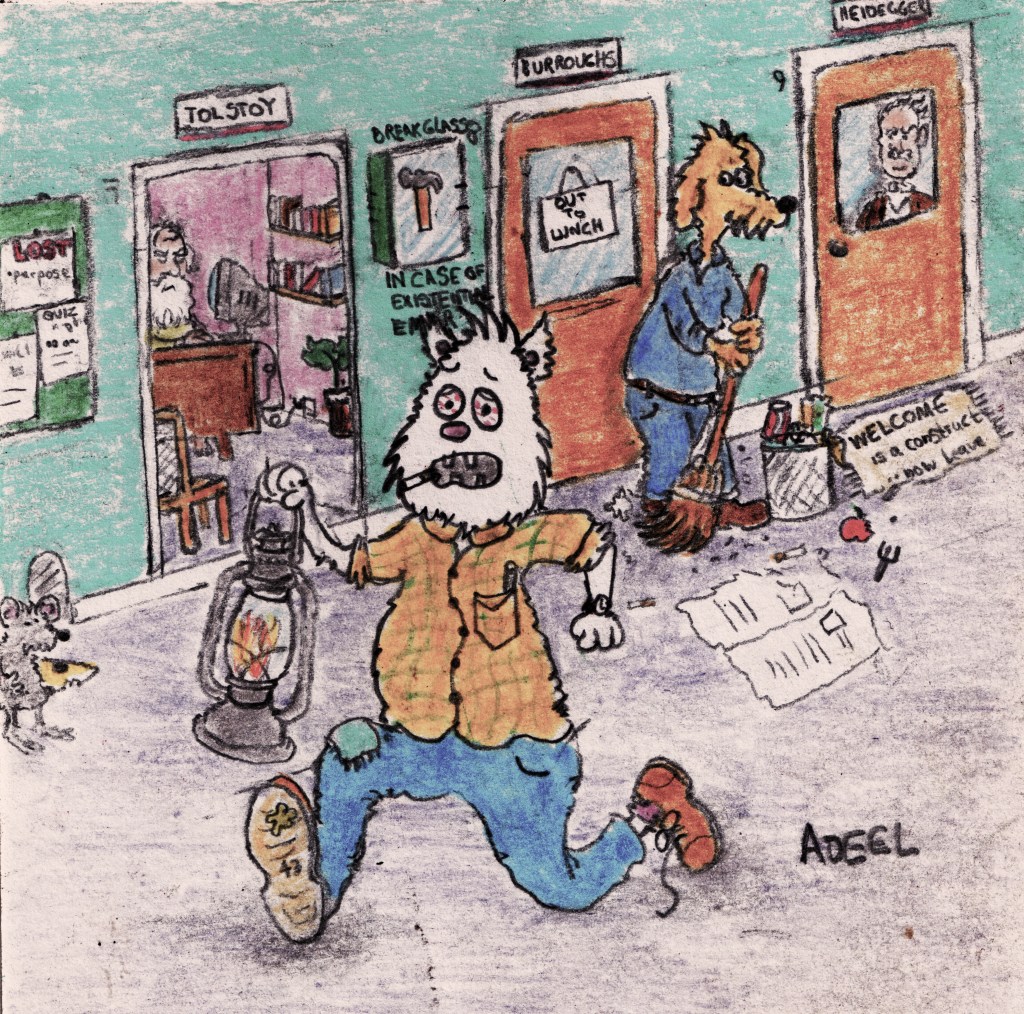
I’ve run amok, swinging a lantern like Diogenes, through corridors, hallways, searching and stumbling from door to door, philosopher to philosopher, chasing the invisible. Ahab’s White Whale. I’ve wrestled with soul, battled with mind, fought with Self. Pulled into every goddamn corner, blind alley – for the slightest glimmer of truth. I navigated through storms and stillness, divine faith to nihilistic despair, transcendence to absurdity, Quantum Science to ontology, and finally, finding a kind of peace — a temporary home in the yellowed, musk-scented, moldy pages of ancient Eastern philosophy.
by Adeel Babree
Just to deconstruct the perennial paradox that mocks all attempts at resolution. Or in much clearer words free of my usual pretense – to get to the bottom of that Universal damn question…
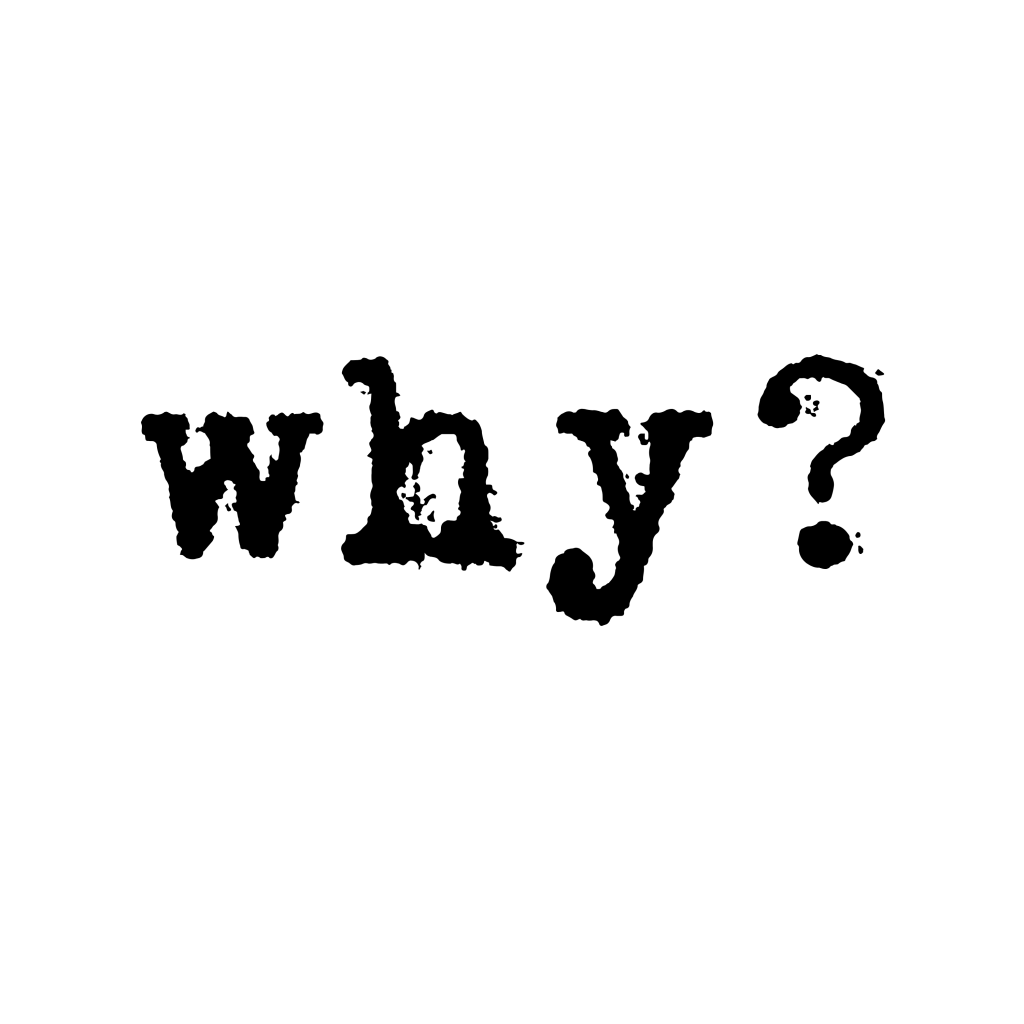
Three letters. That’s all. And the whole Universe comes apart.
Just three little symbols, sitting side by side.
You stare at it long enough, and it starts to shimmer like sunlight hitting a rain puddle just at the right angle.
The W—sharp, fanged like a fork in the road with no signs.
The H—spine-like, the bridge between silence and a cry.
The Y—a slingshot aimed at God, at Nothing, at myself.
It’s a child’s first protest, and a dying man’s last whimper.
It’s what prophets of the desert screamed at the stars.
It’s the bitter growl of scientists wrestling with fluid dynamics.
It’s what lovers say when doors close, and the space widens.
It’s what the writer says to the page that no longer answers back.
But where does it come from?
Not etymologically — who gives a damn about Proto-Germanic roots right now.
I mean from the place. That wellspring. The ache behind the question. The haunted place in the brain where wonder and grief play a game of paddle-ball.
Who was the first poor bastard who looked at a passing thunderstorm, or a dying friend, or caught his reflection in a rain puddle, and thought—
“Why?”
Not how.
Not what.
Not even when.
But why.
The most dangerous word ever born of a human mouth.
It has no edges.
No floor.
No ceiling.
A philosophical sinkhole.
Why is the sky blue but space is black? Why did the dinosaurs go extinct? Why do some people get sick and others don’t? Why do loved ones die? Why does everyone pretend they’re okay after? Why create? Why destroy? Why crave meaning? Why do I want to disappear and be seen at the same time? Why do I feel more alive in a convenience store at 2 a.m. buying engine coolant than I do at a family get-together?
Why are we here? And most important of all-
Why should I even give a damn?
Decades of dreamy nights, staring out nicotine-stained, yellow windows, the truth finally dawned. Much too late in life, I realized that what I had considered the most profound and important question was, in fact, also the most foolish — and vice versa.
A modern thinking man is expected to fulfill a role —a self-imposed duty:
to define, refine, and cram the essence of life into neat, labeled, number-coded boxes, mass-produced for the hungry consumption of the populace.
Always filing, sorting, and reducing:
What is good, what is evil.
What is right, what is wrong.
Light, darkness.
Order, anarchy.
Faith, doubt.
Life, death.
Fat, non-fat.
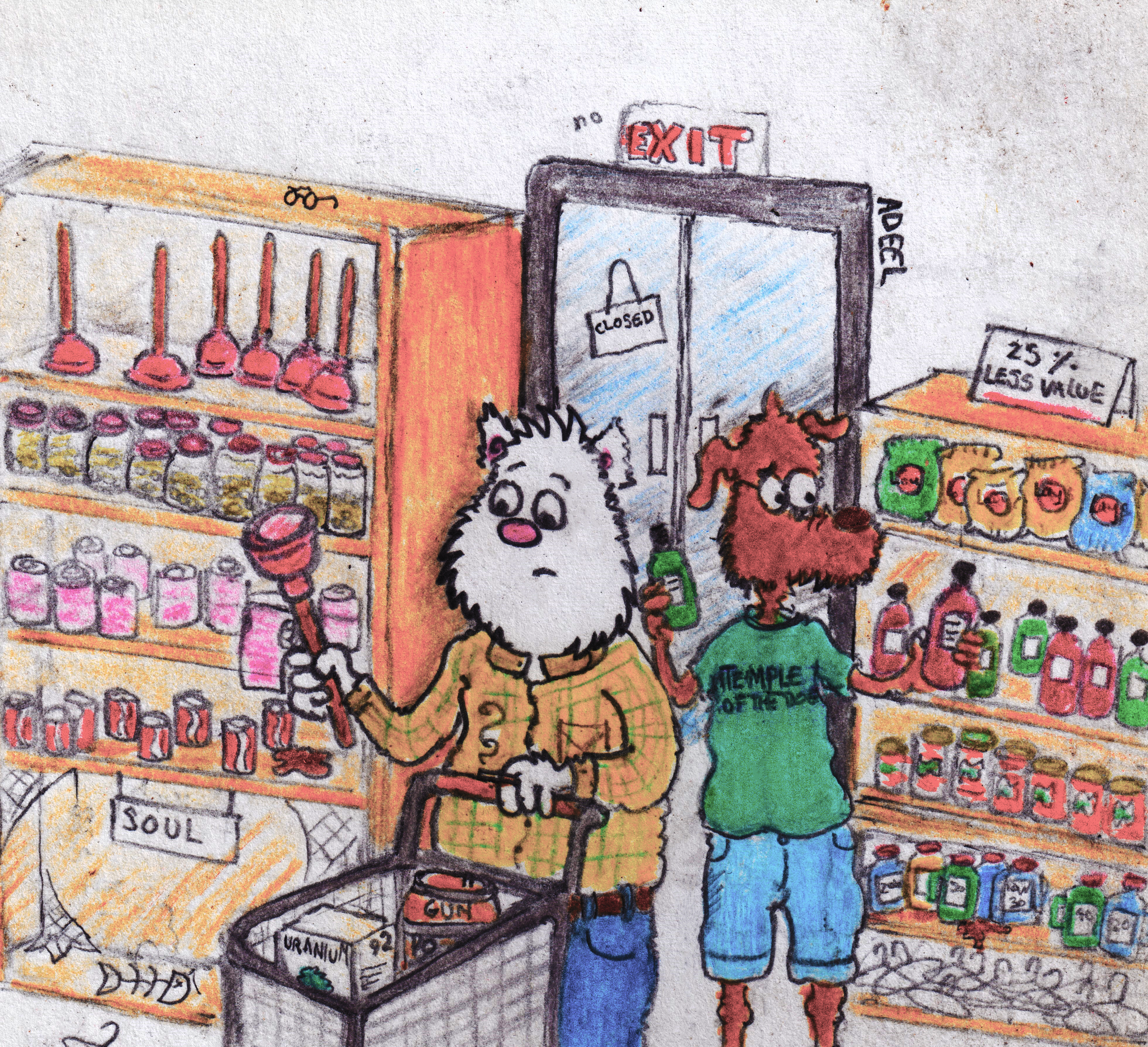
It’s useful, when buying a Coke, or health insurance I’ll outlive, or a plunger on a clogged Sunday afternoon. But for everything else —the real stuff —it fails. Miserably so.
by Adeel Babree
The writer, lost in a trance, rises from the chair again. With the weary reverence of a pilgrim, he paces about in his room, wearing out the polyester of the carpet. Back-and-forth. Back-and-forth. He stirs the coffee with a pinky — just to see if any of this is still real. Takes a sip. Grimaces. Bitter as memory. He walks to the bookshelf, pulls out a book – dog-eared, foxed, spine-weary — and slams it shut again. Dust roars, and floats –ghosts of sentences. He scoffs, not at the ideas, but at this feeble code, this language we swear by, stitched together by apes trying to make sense of thunder and heartbreak.
He shuffles back to his desk like a man returning to the scene of a crime. He writes… “Like a butter-knife performing brain surgery.” He laughs to himself, marveling at the analogy. But then crumples it into a ball, and tosses it in the bin.
“Garbage.”
We’ve burdened ourselves with the impossible – an exercise in futility: to explain something vast, microscopic, and fleeting —in a medium so limiting, and human.
And while through the ages, wily craftsmen came —
Fire on their breath, ink in their veins.
Mystics, visionaries, melancholics —sorcerers of rhythm and metaphor. Keats, Rilke, Eliot, Dr. Seuss —
weaving beautiful tapestries, crafting landscapes of emotion in their usual terrific fashion.
But at the center, their words —volumes of it, always meant nothing.
Because existence is not a paragraph.
Language, no matter how lovely, is a cage.
And for all intents and purposes,
God cannot and will not be contained,
in a word.
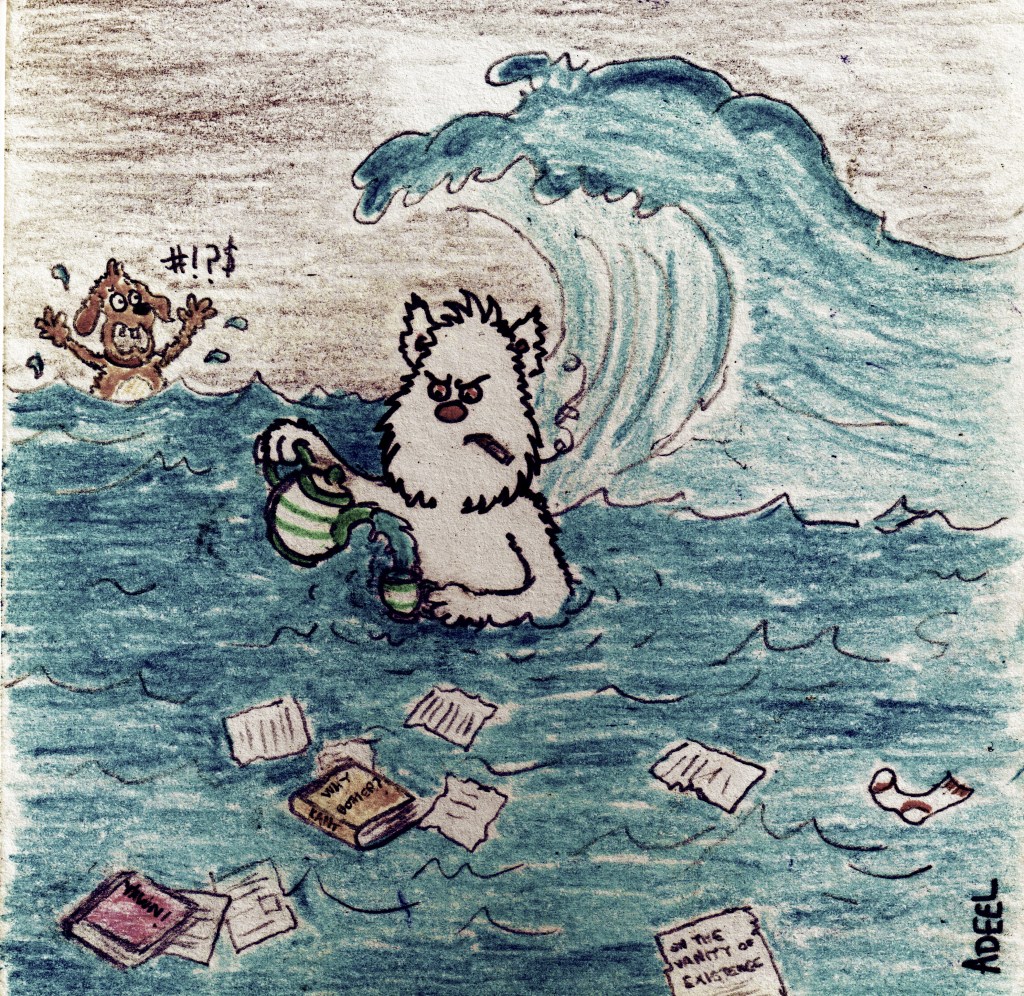
To fit the meaning of life into finite form is to miss its point entirely. As if asked to put the entire weight, burden, and contents of the Pacific into a teacup. The ocean, in all its boundless majesty, churns, and swirls. Its depths unimaginable – its tides carrying with them the watery mumbles of aeons. It is not mere water, but is the breath of the earth, the pulse of life, and the memory of a thousand storms.
by Adeel Babree
And for anyone that dares to go looking for truth, that acknowledgment is most crucial. That it does not exist.
For, it calls upon us—to peel back the layers,
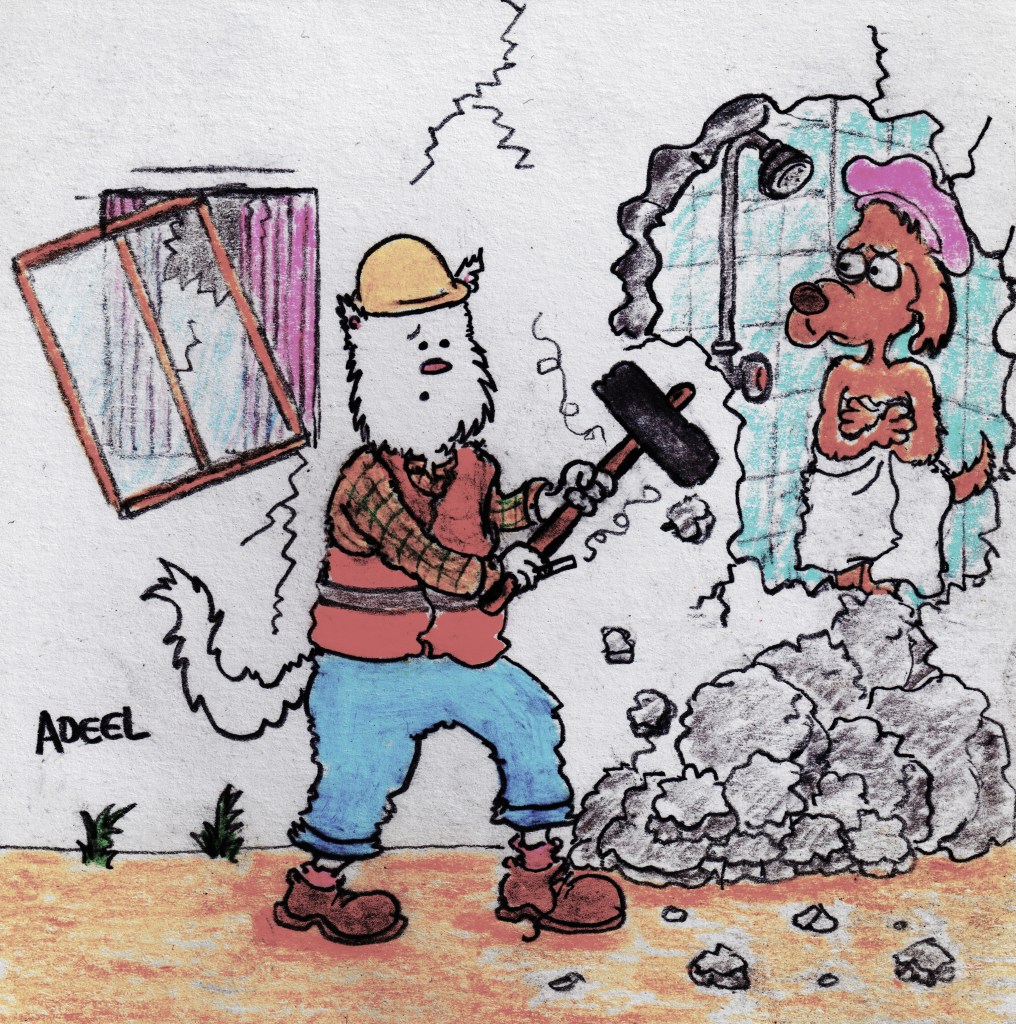
knock down the walls,
storm the bastion with fire and fury—
one metaphor at a time.
Deconstruct.
Dismantle.
Destroy.
The illusion that falsely shapes our lives.
by Adeel Babree
He jerked back from the daydream – like a man surfacing too fast from drowning. He readjusts his spectacles. The lenses smeared with fingerprints and smoke-fat, like stained glass of a Cathedral of doubt. He runs his fingers around his wedding ring, and looks around the room again.
Something stirred.
Not in the room. In him.
Life, he knew, couldn’t be boxed in syllables or diagrams. “Anyone who claims they’ve figured it out is selling something,” he maundered. “Usually a book. A weight-loss program. Real estate. Or a god with a monthly subscription plan.” Because this thing—this mess we breathe through—isn’t a neat, shareable experience. It’s lonely cinema.
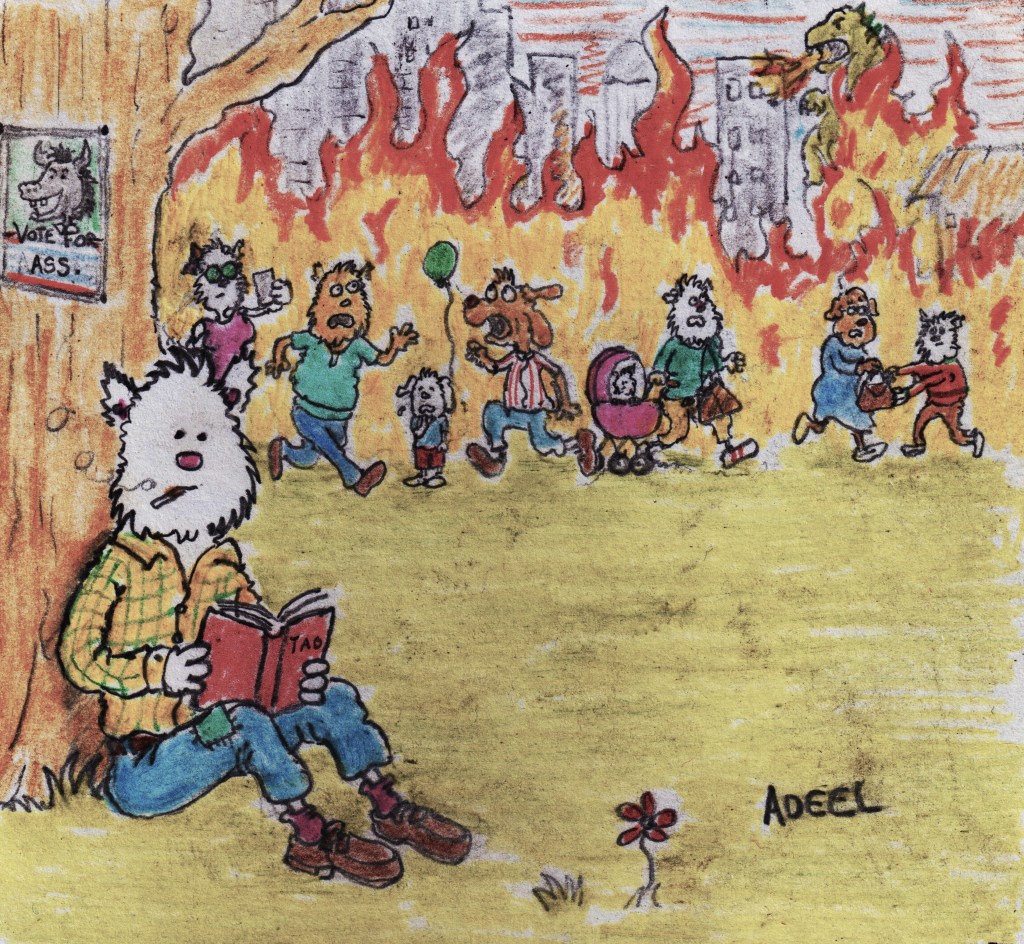
Two towns, side by side — same wailing winds, same gray-collared crows circling electric poles plastered with the same lies from the same mouths. The same smell of diesel, sweat, and heap fire. The same jamun trees lean heavy, their shadows stretching long and lazy over mud and clay walls. And yet—cross the border, just a thin sliver drawn by men long dead, and everything shifts. Perspectives fracture.
The language lurches. The heroes change — and so do the villains. In the name of truth, headlines rewrite themselves. The tea tastes different, even when made the same way — “1 cup milk, 1/2 cup water, fistful of tea, a mountain of sugar— and cooked till death.” Grandmas still sit on verandas, in their creaky old cane chairs, wood splinters jutting like the frayed nerves of an old violin. They talk of days gone by — the same days, maybe, but the stories sound different. The men are taller. The endings are softer. The same war has a different name.
Even reality warps — like a cheap lawn chair left out in the sun too long. The laws of what is true, just, and possible — shrink or expand, depending on where you stand. History rewrites itself. The meaning of the soul is no longer universal — it starts wearing local clothes, adopts new postures, speaks in unfamiliar metaphors.
Ask someone on either side what the truth is, and you’ll hear two separate epics — told with equal conviction, pride, and pain. Like neighbors in identical houses who swear the sun rises differently from their windows. One finds God in the azaan; the other, in the quiet that follows.
And yet we still thirst for a definition that would explain it all. We chase after systems, dogmas, ideologies—to make sense. We want to corral the wild horse of existence into some stable of understanding.
But baby, this thing wasn’t made to be tamed. It bucks and kicks and laughs in your face when you try to name it.
That’s the cruelty—and the comedy—of language.
It was a tool, once. A stick to draw maps in the dirt, to say, “This way. Danger there. Fruit here.” But somewhere along the way, we crowned it king. Now it rules us like a tyrant.
We say reality, and we think that means something.
We say God, and wars break out.
We say time, and become its prisoner.
by Adeel Babree
Words our forefathers wrote in their journals, to understand the stars—we now carry like commandments carved in stone. We inherited their questions, but mistook them for answers.
Why?
Why should the breath of ancient men become a noose around our necks?
Why do we bend the knee to definitions that no longer serve us?
Why do we try to explain things that were meant to be danced?
And yet here you are – breathing, blinking, thinking.
Clinging tight for a story, a narrative, a theme. Just something to hold on to – and explain the chaos, the swirling Pacific in your teacup, and the tired ache behind your eyes at 3 in the morning.
But what if there is no spoon? No hidden purpose. No cosmic script. No plot twist in the third act.
Just this moment.
The silence between the notes of Miles’ trumpet.
An electric hum of the fridge.
A spider – hanging by its silken mess in the windowsill.
The glow of the lamp-light that touches the dust of a framed picture of your father.
The after-taste of a cigar – lingering like regret you can’t spit out.
The writer pats his denim pockets like a man searching for lost time, fingers brushing lint, a bottle cap, and the crumb-soft remains of a biscuit he didn’t remember eating. He digs out the cigarette-lighter like a magician revealing his final trick. He lights up another cigar. Takes a draw. He stares at the page again. He waits for the sentences to mean something—anything. Words come, limp and lame. He scrawls, sighs, crumples. Another failure tossed into the bin with a soft thud, joining the others like shot birds. The room stinks of ink and defeat. Maybe the words have left him. Maybe they were never there.
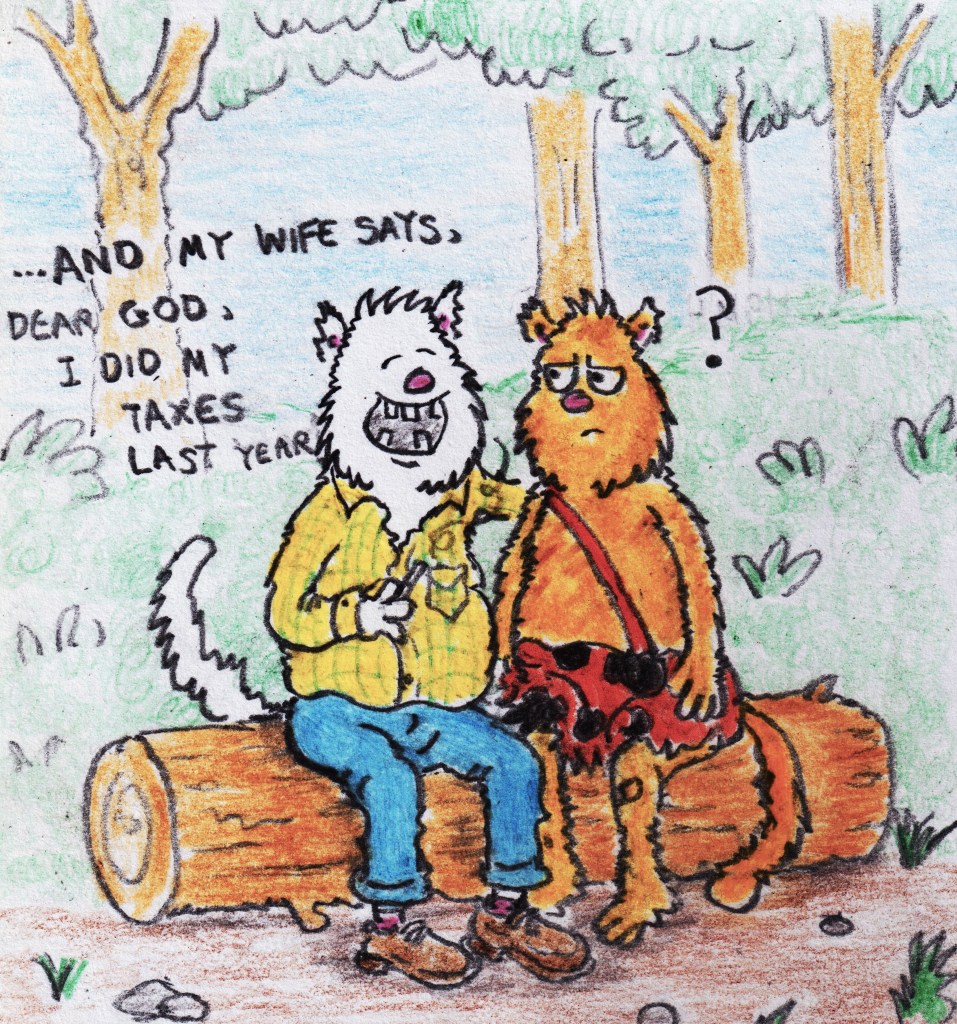
While philosophy strains to liberate us, some cultures have lived that freedom for centuries—quietly, instinctively. Like the Pirahã of the Amazon, who move through the world without the weight of linguistic obsessions. They don’t need words to define left from right, they don’t need clocks to measure time. The supernatural doesn’t enter their frame of reference. Their oral traditions are not bound by the Western need for structured stories—with neat beginnings, middles, and ends. Instead, their tales drift like river mist—fragile, momentary, and rooted in the present—never concerned with grand arcs or inevitable conclusions, speaking only of what is seen, heard, and felt now.
by Adeel Babree
The Universe does not argue its case—it simply unfolds. It doesn’t need to justify itself, nor does it follow the path of our constructed stories. “Reason” and “purpose” are tall tales we tell ourselves in the dark, like campfire hokum passed from one generation to the next. Byproducts of our conditioned, linear thinking, desperately trying to give shape to the infinite beauty of existence.
And yet – the question still stands.
After peeling back of the wallpaper, the tearing down of walls—what remains?
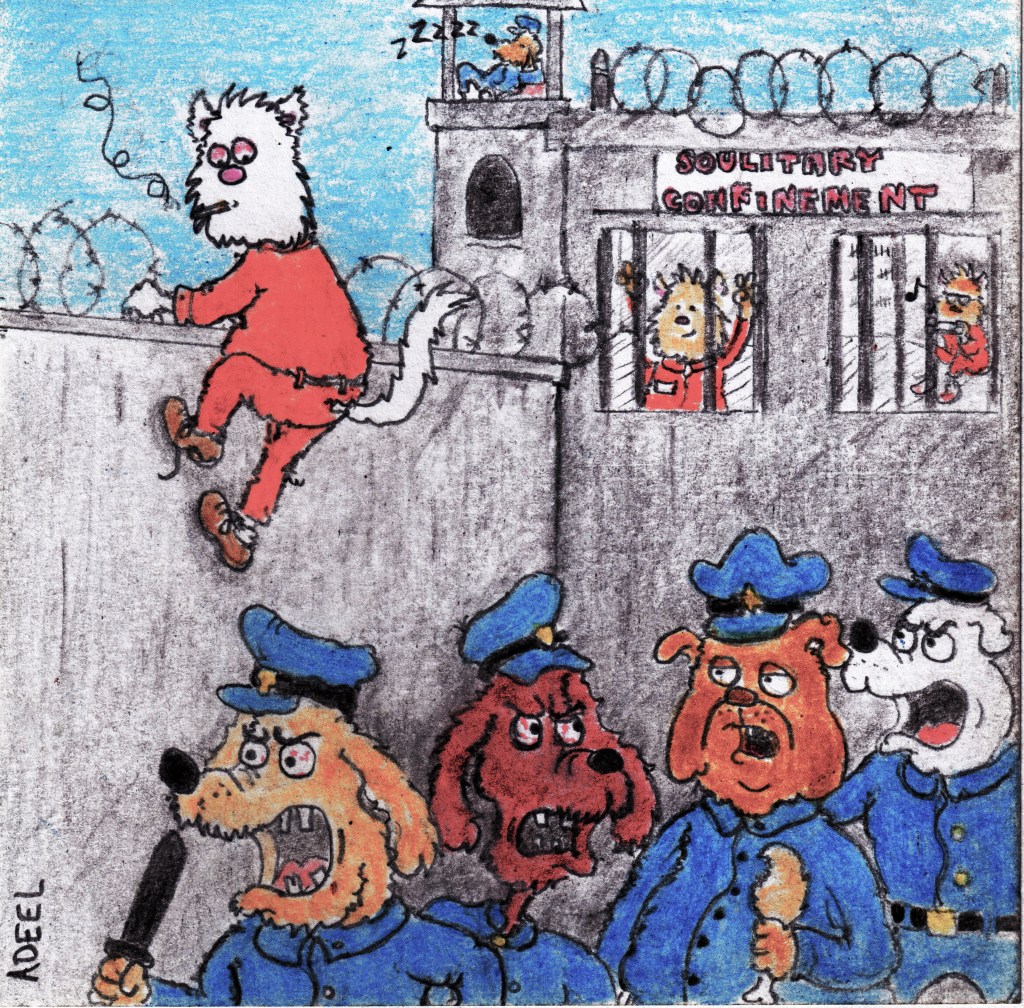
Each of us — is handed a brush,
sometimes broken, sometimes bristling with fire —
and told nothing.
Do whatever the hell you want with it.
by Adeel Babree
Because there are,
No instructions.
No blueprints.
No manuals.
No prophesies from Delphi.
Only the urgency,
the itch,
that burning itch –
to smear, sketch, splatter, and scream
onto that piece of paper.
It is your chaos to compose.
Your absurdity to sculpt.
Camus ached that our only triumph is rebellion — to imagine Sisyphus happy, pushing his boulder not toward meaning, but toward motion.
Buddha, in the deep of jungle, mind and spirit – broke all chains, not to transcend, but to land.
And Nietzsche, the madman of the hallways, didn’t kill God out of spite — he did it to make room for you.
For your canvas.
For your becoming.
For your right to define yourself — in colors unseen, in verses unspoken.
They weren’t preaching. They were merely taking you by the hand, and leading you to this moment.
This breath.
Back to this page.
Neat blue lines, tidy red margin,
Pasta stains, pencil shavings,
and cigar ash –
Fallen everywhere,
but the ash-tray,
sitting at your desk, in the late hours of night.
Blank, but brimming with what never was.
A space of infinite possibility— a new beginning.
The sky outside now pale blue, but the writer hadn’t noticed. The night had folded over. Slouched in that old creaking chair, the one that groaned with every breath he took, like it too was tired of holding him up. An empty mug perched on a stack of unpaid bills, and the air reeked of burnt tobacco and something older—maybe failure, maybe resolve. His fingers were stained with ink and ash, his lungs wheezing softly from one cigar too many. He coughed once, sharp and dry, then rubbed his eyes—red-rimmed, haunted, but strangely at peace.
Another hour crawled past. Songs of birds, and the murmur of traffic begins. Life moves on – right on schedule. Yet the writer sat there, still, like the Pirahã.
Unwritten.
Unsaid.
A man empty—but overflowing.
Exhaling slow into the tender gold of the morning, he asks,
Where do I begin?


 ADEEL BABREE
Leave a comment