CHAPTER I
The Farce Awakens
Don’t go around tonight,
Well, it’s bound to take your life,
There’s a bad moon on the rise.
– Creedence Clearwater Revival
A man in his forties sat hunched in his chair. Shirt tucked in, beat-up sweater over it, trousers stained with engine oil and the grime of yesterdays. A cheap cigar jammed into the corner of his mouth. Before him, a half-finished cup of yesterday’s tea, and a Faulkner book splayed open, notes scrawled in his awful handwriting—mostly nonsense, some genuine complaints, a “things-to-do-today” list, and a doodle of a man in his forties sitting hunched in a chair. He crossed out “don’t kill yourself,” off his list, chuckled at the doodle, sighed, and flicked on the TV.
It was Sunday. Nothing was happening. Nothing ever happened.
He flipped the TV channels like a clock hand ticking through another meaningless hour. Tick. Tock.
Commercials, news, news, talk show, drama, more news, reruns, commercials. Tick. Tock. Nothing worth thinking about.
But something in the room felt wrong. Something that didn’t belong to him or the world outside. A strange hum, a pull in his chest, a tickling at the back of his skull. He couldn’t name it. Couldn’t explain it. He just knew. Like the giddy feeling in the gut just before something terrible happens. The last seconds before a car crash. A sound he couldn’t hear yet: crunch of metal, glass breaking, the hiss of the coolant.
And then the TV pulled him in.
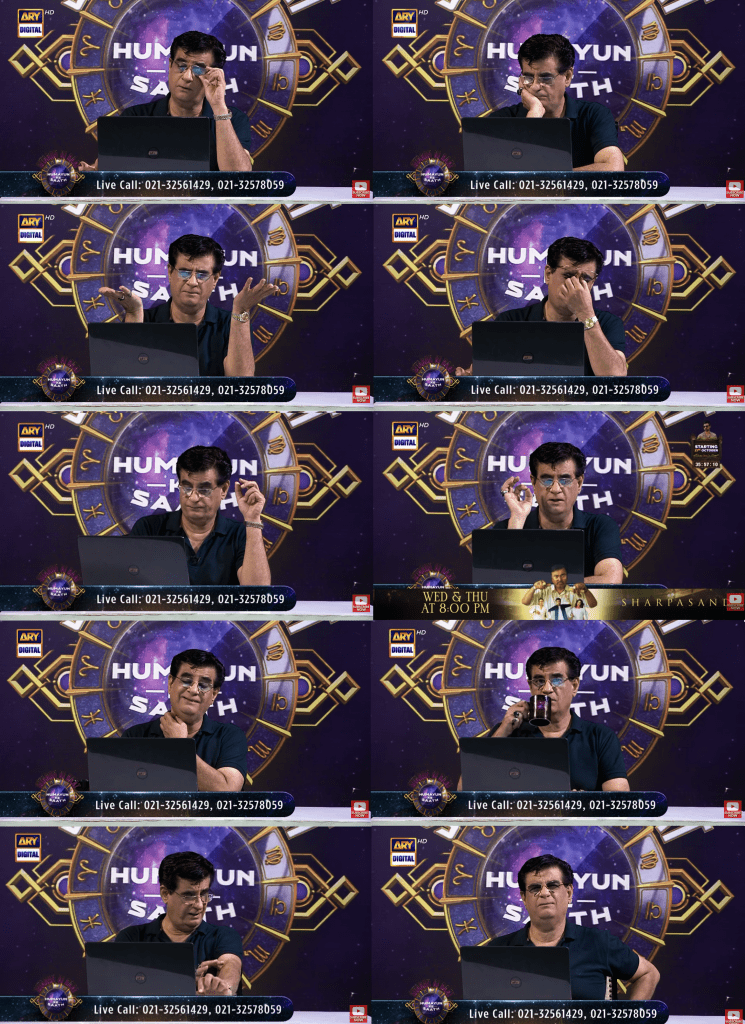
“Greetings, ladies and gentlemen. I am Humayun Mehboob with the program “Sitaron Ki Baat Humayun Ke Saath” said the man on television.
The setup was plain enough. An astrologer taking live calls, interprets their charts, and gives guidance or predictions based on the stars.
Our disgruntled protagonist looked on, waiting for the punchline. There was none.
All good sense urged him to change the channel, but he couldn’t—like someone staring at a building on the verge of collapse
He sat like a rock, cigar gone cold, still sagging from his mouth, eyes locked on the screen. He realized, in that slow, nauseating way, that he really didn’t know if he’d ever been unlucky. Maybe he had. Maybe he hadn’t. He’d never really thought about luck before. But it didn’t matter. Because now he knew, with bare, brutal clarity, that he was going to have bad luck for the rest of his life.
Now that Humayun Mehboob, the Dark Lord of Bullshit, had arrived.

And the farce had only just begun.
CHAPTER II
80 Grams
Humayun Mehboob sits.
Behind a futuristic-looking desk.
And by “futuristic,” I mean the way people in the 1950s imagined the future — Formica furniture, Sputnik lamps, silvery jumpsuits and rockets made out of tinfoil.
It looks like a prop lifted from Space Patrol, or maybe an unfinished art project from a kindergarten classroom — abandoned, never graded, now growing mold and other things in the janitor’s closet.
The whole thing looks like it was built from discarded PVC pipe.
Yet there he sits — deadly serious.
Like he’s about to deliver a national address — perhaps declare a state of emergency, maybe even war.
I can always tell when a man’s up to no good.
Nobody that serious ever means well.
Mr. Mehboob has his laptop open, pretending that he’s calculating, tracking the cosmos, measuring light-years, mapping infinity like some moonlighting intern at NASA, but I know, he’s just playing Minesweeper.
He looks tired.
Not the “I work two jobs, the bills are piling up, and the toilet’s leaking again” kind of tired —
but existentially tired.
The kind of tired that eats the marrow of bones.
Maybe he once wanted to be something else —
a poet, a singer of ghazals, a man with a dream —
but woe, he couldn’t shake off the grip of fate, her cruel constellations.
Now he sits there, stuck —
glued like the cheap wallpaper of fake stars behind him,
reading imaginary coordinates for a living.
He looks a bit like the journalist Kamran Khan, if Kamran Khan had slept well, shaved, and washed up before leaving for work. His fingers are heavy with rings — big stones, the kind that could make you mistake him for a geology exhibit.
But his facial expression — that eternal constipation — either the chair’s killing him, or he’s got a bad case of karmic hemorrhoids.
The first affront — he calls the stuff he sells science. Proper science. Pfft. It is as much science as Jane Fonda’s outfit in Barbarella. Then he adds, “Of course, only God truly knows the unseen.”
Oh yeah, there it is — the classic fraudster disclaimer, the get-out-of-hell-free card.
Like a salesman saying, “This blender might explode, burn your house down, but hey — destiny is in God’s hands.”
He leans back, satisfied with his disclaimer, and flicks a switch on the console.
“All right,” he mutters, voice suddenly official, “let’s see who’s calling.”
The line clicks live.
Caller #1
Humayun squints at the camera, forehead wrinkled like an unwashed bed-sheet, and asks the caller, “when were you born?”
23 May 1990, she replies.
Next, he asks what time she was born.
Yeah, sure, buddy. She probably checked her Casio right before popping out. “Oh, 8:03 a.m. sharp, nurse. Log it for future planetary council.”
And where, he further inquires.
“The hospital, you space cadet. Where else? In the backseat of Klingon D7 Battle Cruiser flying over Ceti Alpha V?”
The woman says, “Karachi.”
Humayun nods gravely, as if she just told him she was born during a solar eclipse over Pompeii.
What does it matter what city she’s born in?
Will her destiny really change if she was born in Akmola, Kazakhstan — which was renamed to Astana, then Nur-Sultan, then back to Astana in a short span of 25 years?! I know, I know, I am funny.
Then, out of nowhere — the man asks,
“Have you conceived yet?”
GREAT FALLOPIAN FALAFELS, BATMAN!?
Hold yer horses, cowboy. At least buy her a coffee first. The gall! Talking fertility like he’s asking the time.
Visibly concerned, the good sport Humayun is advises both husband and wife to ingest a potion made from banyan tree sap.
Oh great, she’ll give birth to Swamp Thing. Congratulations, ma’am — it’s a boy. A girl. A shrub!”
Meanwhile, he’s burping between his words.
Maybe he should use some of that banyan goo himself — for indigestion and interstellar hallucinations.
And right when you think it can’t get any worse, Nauman Ijaz’s sinister face pops in mid-burp as a plug for the drama SharPasand.
That face alone could sterilize an entire neighborhood.
Caller #2
DOB: 19 June 1991. 2 p.m.
Who the hell is born at 2 p.m.?! Middle of the day! People stuck in traffic, standing in bank queues, confined to their offices… microwaving two-day-old pullao in that filthy office microwave.
Humayun looks at her chart and says, “You’ve got a good horoscope, but your house of marriage is in the shits.”
The man talks like a property dealer. “Solid foundation, weak structure. But you can always renovate later.”
He asks what she does. “Banking sector,” she says. “Eight years on the job, no promotion.”
Maybe because you’re calling TV shows during office hours, sweetheart.
She says she’s been broke since 2024.
Honey, it’s not the moon, it’s inflation. The whole country’s been broke since 1947.
Humayun offers his premonition. “You’ll be broke till May 2027, but then things will get better.”
Oh goody. I’m sure the Federal Board of Revenue will be very understanding about why I haven’t filed my taxes over the past few decades. Hey, Zardari’s been pulling that stunt since 1987.
Then — a moment of sheer accidental brilliance.
He says, “In the eyes of God, nothing has any significance.”
Boom. The man just nuked his entire profession, debunked his own so-called science on live TV.
I am beginning to like this guy, I think to myself.
For a fraction of second, he’s Buddha, Hume, Nietzsche – all combined. But the very next, he’s back to being the used-car salesman.
“Feed the birds every Saturday,” he adds. “Eighty grams of birdseed. And also, don’t wear the color of blue.”
What if she’s a Smurfette?!
And then he advises some supplications — 3x 100x 100x 100x 100x 3x 3x 3x 3x 3x 3x
Man, these combinations are trickier than pulling off the Mortal Kombat Kintaro Morph fatality.
Caller #3
The woman says, she tried for the Federal Public Service Commission test. She cleared the written exam but failed the interview.
Humayun’s face twists into a smile — sadistic, gleeful. The sort of thing a child might wear when the math teacher slips and breaks her hip.
For the first time all episode, his eyes light up. The old romantic in him wakes from the dead.
He drops a couplet like he’s doing the midnight poetry hour on the radio.
“Tooti kahan, kaman manzil paye pohanch ke,
Do chaar hi haath jab lab-e-bam reh gaye.”
Where the bow broke, the arrow reached its mark;
Only a few hands remained when the edge of the roof was all that was left.
Whoa. Once again, this man catches me off guard. He’s no fraud, I tell myself. He’s just a misunderstood poet. A man who longs to read Habib Jalib, Mazhar Imam, Allahabadi, not the tea leaves left in your morning cup of tea.
Then — poof — it’s gone. He says.. “Your Rahu is in transit.”
What the hell is a bloody Rahu?
I Google Rahu. Turns out it’s not even a planet. It’s an imaginary point where the Moon’s orbit crosses the Sun’s path.
An imaginary point! Imagine.
Perfect. The man’s making predictions based on things that don’t even exist.
It’s poetic symmetry — lies orbiting lies.
He dusts off his arm — maybe dandruff, or maybe star dust from that fake wallpaper of stars behind him.
“Life will go on. Day by day. But it will go by” he concludes.
That’s not astrology, man. That’s just Monday.
Finally — the same prescription again:
Eighty grams of birdseed.
At this point, I’m not sure if I’m watching an astrology program or a segment on How To Overfeed The Birds on Animal Planet.
He takes a sips from his cup — and for a second, I swear, I see it:
The sadness of Mr. Mehboob.
The awareness.
That deep, quiet realization that even he doesn’t buy the crap he’s selling.
But the cameras are rolling. And Rahu is still in transit.
And so is Humayun Mehboob.
Then came Calls #4 through #7 — a four-part symphony of cosmic flatulence, each movement riper than the last.
A mother in distress asks about her son. Humayun stares at his laptop. Feels a disturbance in the force-field — probably in the lower intestine. He prescribes some over-the-counter, ready-to-use, fun-for-all-ages black magic voodoo. No assembly required. And dishwasher-safe.
Take nine small bones. Rub them all over your son every Tuesday, he says. Then toss to stray, rabid dogs. The bones, the bones not the boy, damnit.
Next, a wife calls, inquiring about her husband.
Already suspicious behavior. You don’t need a TV astrologer, lady. Just check his Spotify Wrapped.
She adds my husband’s been in a “flux” — up, down, down, up, down, up.
So, basically, a load-shedding schedule.
Humayun, after consulting the stars concludes:
“Your husband’s a master of conversation, great communicator, and a big, fat liar. He lies with such great conviction that even his lies sound true.”
Wait.. is he describing her husband or himself? Did the call just take a Freudian U-turn?
COMMERCIAL BREAK.
While Humayun sells his soul to Palmolive, I sit here questioning mine. Retracing the crooked corridors of my days, the choices, the compromises, the tragedies — wondering how I ended up here, on a beautiful Sunday afternoon, staring at the flickering light, and watching this televised sewage.
But enough navel-gazing and spiritual whining — Humayun’s back!
After the break, Mr. Mehboob returns to his flock — a few thousand bored housewives, a skeptic, and a handful very anxious birds — and announces that his office is in the PC Hotel, Karachi, should anyone wish to book an appointment.
Ah, now it makes sense. No wonder he’s been burping between sentences. He’s been gluttoning on the buffet.
Another caller. Another mother, another son.
She only tells him the kid’s name, and without missing a beat, Humuyun goes, “Nope. Not working. Change the name.”
Maybe that’s why Kazakhstan keeps changing city names. They probably hired this guy. Ha ha ha? Man, I am hilarious.
And again, he prescribes 80 grams of birdseed—and, for the poor, three bananas every Thursday.
With nearly half the country below the poverty line, how do I choose which poor people get the bananas? Is there a queue system? Do I go, “Sorry, man, you’re the fourth poor. Try again next week”?
Mr. Mehboob, you’re something. The more I watch you, the more I realize: you’re either full-blown batshit crazy or the second coming of Kafka.
The last caller wants to know about her sister’s suitor. She says, her sister was born on 8 June, 1999.
8th June, 1999?!?! I nearly spill my tea!
By the great thunderous grizzly beard of W.G. Grace?!
No, no — not a good sign. Not a good sign at all — my inner astrologer wakes up.
That was the night Pakistan fell to India in the Super Six. Even Moin Khan — always twitching and hustling, stealing singles like a pickpocket — couldn’t pull it off, and Pakistan folded for 180.
Tsk. Tsk. She was born the day flags went up in flames, sirens tore the sky, and our middle order fell to pieces—yet again. Cursed from the first breath, I swear it. Cursed to stumble through every misstep the world could offer.
Humayun squints at the screen once more and comes up with an aggregate..
“The man is 60% good.”
Sixty percent?! What kind of metric is that? He measures men like a weather forecast: 60% chance of rain, but sunny skies tomorrow.
Humayun approves the proposal, gives his blessing… even if the remaining 40% of that man is a liar, an adulterer, and, God forbid, an Atif Aslam fan.
But… Humayun’s final warning fell like thunder from the gods themselves: The bride shall not wear red, lest the heavens be torn asunder in wrath, and the Lord cast down a deluge of blood, that the mountains be drowned, the fields laid waste, and the very bones of the earth ground to powder beneath His fury. (Editor’s Note: Clearly, the writer has clearly dialed the drama to eleven—apocalypse-level madness and exaggeration for cheap theatrics)
And with that last dire caution, the program ended.
Order of the Court
Res iudicata
In the matter of The The People vs. This Steaming Pile of Bullshit, the court finds the defendant guilty on all charges: reckless misuse of the planets, unlawful endangerment of the local aviary community, and presenting himself in public while looking like that.
The evidence is overwhelming, the alibi is laughable, and the horoscope he submitted as a defense is hereby stricken from the record on grounds of profound stupidity.
Bang.
The gavel strikes.
Case dismissed.
SUBSECTION 1.1 a
On the Quantitative Determination of the Subliminal Essence: the human soul
In 1907, a Massachusetts doctor named Duncan MacDougall dragged six dying patients onto a scale and declared he had measured the unmeasurable: the exact weight of the human soul.
Twenty-one grams, he said.
Not twenty, not twenty-two.
Twenty-one.
He spoke like he was weighing flour for muffins he planned to bake later.
Of course, the whole thing was rubbish—leaks in the logic, holes in the method, science held together with some staples and a whole deal of misplaced confidence. And truth be told, I don’t even know if we have a soul. Most days mine feels more like a rental.
But—just for fun, just for the absurd dance of it—let’s pretend old drunken Duncan was right. Let’s pretend every soul tips the cosmic scale at a neat, delicate 21 grams.
When I finally turned off the television, my brain felt lighter, my faith in humanity thinner, and my soul… well… my soul felt emptier by a clean 80 grams.
Do the math.
I’m running a 57-gram deficit.
A soul overdraft.
By the wandering soul of a bewildered Bimbisara, that can’t be good.
Grrreat.
Just great.
I suppose I’ll have to stop by the pharmacy in the morning and ask if they’ve got any soul vitamin supplements—extra strength—before I disappear altogether.
EPILOGUE
“I got no time for private consultation,
Under the Milky Way tonight.”
It all began when some damn fool, thousands of years ago, looked up at the night sky and said to his apeman buddy,
“Hey, doesn’t that glowing dot kinda look like something?”
“Like what?”
“Your mother?!”
And they both laughed themselves into a roaring fit.
Thus began two of humanity’s longest-running traditions—astrology, and, of course, yer mama jokes. The latter, naturally, has far more scientific grounding.
Once upon a darker night, when fire was the only god men could make, the ancients looked up and saw the heavens aching with meaning. The night sky became their scripture, the constellations their priests. Every pulse of starlight carried the weight of billions of years. They sensed gods in the patterns, needing poetry to make sense of hunger, loss, and the infinite dark. “Ye stars! which are the poetry of heaven…” Byron bled on pages.
The Babylonians saw the stars as a way to interpret the will of the gods, predict events, and make sense of an uncertain world… or at least decide if it’s worth betting a few drachmas on the next bloody chariot race. The Greeks took it one step further into the madness — gave the dots silly names, spun sillier stories around them, chained Andromeda to a rock and in turn, made the first shitty space soap opera.
Meanwhile, travelers read the stars, hoping they point somewhere worth going. Sailors spoke to Polaris across black oceans, trusting her faint glimmer more than their own hearts. Nomads charted deserts by constellations they knew by name. The stars were quiet companions then — not therapists, fortune-tellers or asstrologers, but distant, faithful lights. They didn’t speak, yet they stayed. And that was enough.
Millennia later, equipped with satellites, GPS, and data maps, yet we wander no less blindly than the nomads of old, lost in the heart of the desert. We consult the stars still, not for bearings, no, but to figure out who to marry, where to invest, what career to pick—or if that new stainless‑steel 15mm precision Hitachi beard trimmer is worth it. (It is, damnit, it is!)
The ancients looked up for direction. We look up for validation. Am I good enough? Am I pretty enough? Smart enough, rich enough. Is my ass too big? Does plaid make me look fat? Did they get a kick out of my ‘yer mama’ joke? Well.. did you?! DID YOUUU?
Somewhere along the line, we replaced that childlike awe, wonder with anxiety and dubbed it “spirituality.”
At one point during the show, Mr. Humayun Mehboob told a caller, that if she did all the things he prescribed, the stars shall bless her son with it all: honor, prestige, money, fame. And that’s where the mask slips, the incense burns out, and the cheap cologne of capitalism takes over. Astrology was never about mysticism or the stars — it’s Forex trading with zodiac signs, a lottery ticket for the lonely, crypto for the spiritually confused — just another hustle for status, validation, and the illusion of control.
Mankind has discovered penicillin, split the atom, mapped the human brain, sent rockets punching through the stratosphere — and, hell, even invented humanity’s greatest invention: the potty. And yet we still pray to burning rocks millions of miles away, some long dead. It’s just bullshit older than recorded time, polished and repackaged, peddled by hustlers wearing more rings than Saturn, hawking luck like detergent and destiny like Coca‑Cola. And we just sit there — bathed in blue light — the self-pitying dumbshits we are — waiting for the universe to send a sign that maybe it’ll all be okay. It probably won’t. Only because we decide what ‘okay’ means.
The true tragedy is not superstition; it is surrender.
Surrender to the abyss of thoughtlessness, to the abdication of reason and responsibility. Men and women hand over their hours, their bodies, their very selves to the sick sense of humor of the heavens, moaning, ‘Oh, dear God, why me? Why me?’
Humanity cannot endure the blank page. It cannot swallow the raw taste of chaos, of chance, of its own goddamn free will. So it seizes whatever scripts it can find—charts, horoscopes, celestial maps—anything that promises an escape from the responsibility of choosing. Even when these scripts are etched in starlight and spacebunk. They cling to them as though life itself depends on it, as though the cosmos might finally acquiesce to their cowardice.
But the Cosmos carries on without a care. Galaxies collide, suns collapse, planets spin, black holes vomit the ancient plasma of a thousand yesterdays from their bellowing, sick guts.
Orion’s Belt isn’t holding your life together. The Big Dipper doesn’t care if it’s raining and your shoes are all worn out and full of holes. No matter how much Shelley makes you believe it, the moon doesn’t weep for mankind. She’s just a cold, dead rock with sexy lighting. And the planets don’t pull your moods; the gravitational tug of the nurse who smacked your newborn ass had more effect than Neptune ever will.
This universe keeps no tally of triumph or failure. There’s nothing to win, nothing to lose, nothing to fix. Life is a flicker, a brief combustion of chance — and then.. poof.. it’s gone. You could marry your soulmate, go broke, die heroic, or choke on a jellybean — and the Milky Way won’t even fart in your direction.
But…
You don’t want to hear all that, do you? You just came to see if your ex-wife still thinks about you—and secretly hope she’s just as miserable, lonely, and single as you are… and maybe, if the universe is feeling generous, it’ll cut you some slack before entropy does the rest.
Well then… children of the cosmic night, dig this.
All of you feeling lost, needing a bit of guidance, lemme lay it straight: here’s your horoscope. The only one you’ll ever need. Money-back guarantee. (Keep the receipt, just in case!)
The stars don’t give twoshits about you —
and maybe it’s time you stopped giving a damn about them, too.
“The fault, dear Brutus,
is not in our stars, but in ourselves.”
 ADEEL BABREE
Leave a comment